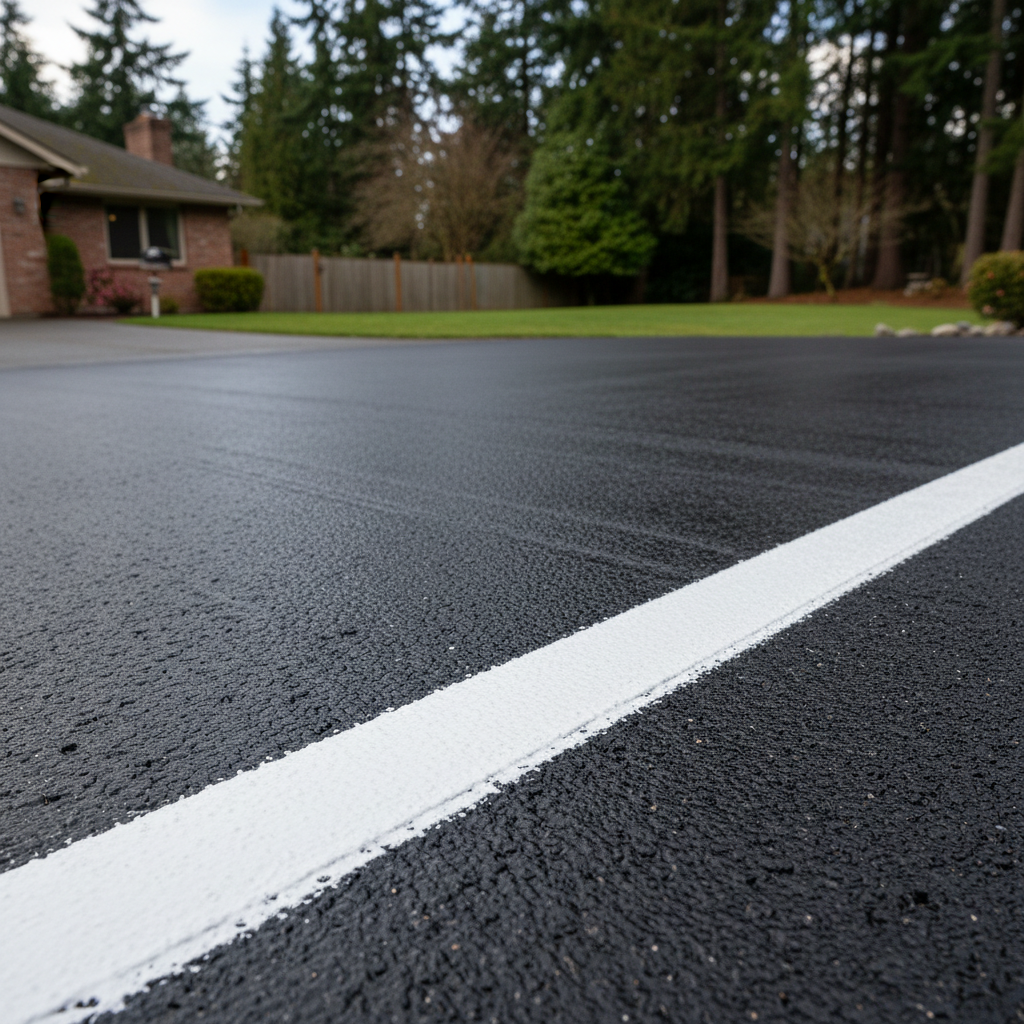
Do I even need striping for my residential driveway or private road?
That's a good question, and honestly, it really depends on what you're trying to do. For most single-family home driveways, you probably don't *need* striping in the same way a big commercial parking lot does. You're not trying to guide dozens of cars or mark specific parking spots for customers, right? But, I've definitely seen plenty of homeowners in places like Bridle Trails who have longer, shared driveways or private access roads that serve a few homes. In those situations, striping can actually be super helpful.
It can clearly show where traffic should go, mark visitor parking spots, or even point out where you *don't* want cars parking — like near a fire hydrant or a really tight turn. Got a basketball hoop on your driveway? We can stripe a court for that. Or maybe you just want a clean, finished look for your new asphalt surface. It's all about making things work better and look good for your specific property.
What kind of paint do you use for residential striping? Is it different from commercial?
For residential projects, we typically use the exact same high-quality, durable traffic paint that we use for our commercial jobs. There's no special 'residential-grade' paint that's somehow worse, thankfully. We're talking about specialized acrylic or water-based traffic paints that are made to stand up to vehicle traffic, UV exposure, and our lovely Kirkland weather – all that rain and temperature fluctuation we get. It's specifically formulated for good adhesion to asphalt and long-lasting color retention.
Sometimes, if a homeowner wants something really specific or has a unique application, we might talk about specialty coatings. But for standard line marking, it's always the professional-grade stuff. You wouldn't want us putting down some cheap spray paint that'll fade in a month, would you? We use the good stuff so it lasts.
How long does the paint take to dry and cure? Can I drive on it right away?
This is a big one, because nobody wants to mess up fresh striping. Generally, traffic paint is 'tack-free' pretty quickly, often within 15-30 minutes. That depends on the temperature, humidity, and how thick we apply it. 'Tack-free' means it won't transfer much if you lightly touch it. But here's the thing: 'tack-free' isn't 'fully cured.'
For light vehicle traffic, I usually tell folks to wait at least 1-2 hours. If it's a cooler, more humid day, or if the lines are particularly thick, it's better to give it 3-4 hours. The paint really needs to fully bond and harden to the asphalt. Driving on it too soon can cause tracking, smudging, or even pull up sections of the paint, especially if your tires are hot or you're making sharp turns. It's always best to play it safe and give it more time if you can. We'll always give you a specific recommendation on the day of the job, based on the conditions.
Can you stripe over existing, faded lines, or do they need to be removed?
Most of the time, yes, we can stripe right over existing, faded lines. As long as the old lines aren't peeling, flaking, or creating a big texture difference, applying new paint directly over them is the standard way we do it. It actually helps us get the alignment just right, and those old lines can act as a guide. We'll clean the surface thoroughly first, of course, to make sure the new paint sticks well.
Now, if the old lines are really chunky, severely flaking, or if you're looking to change the layout entirely, then we might need to think about removing them. That usually means specialized equipment like grinders or sandblasters, which adds to the project's complexity and cost. For most residential refresh jobs, though, a good cleaning and a fresh coat of paint over the old ones works perfectly. Ace Asphalt Paving makes sure the surface is ready before we even think about painting.
What's the best time of year in Kirkland to get striping done?
The best time for asphalt striping in Kirkland, just like most asphalt work, is when it's dry and not too cold. That means spring, summer, and early fall are your prime windows. We need ambient temperatures to be consistently above 45-50°F (around 7-10°C) for the paint to cure properly. Even more important, the surface needs to be dry, and we need a forecast that promises no rain for at least a few hours after application.
Given our Pacific Northwest climate, those dry stretches in July and August are ideal. But we can definitely get good work done in May, June, and September too, as long as we pick our days carefully. Trying to stripe in the middle of winter when it's cold and damp is just asking for trouble – the paint won't stick right, and it won't last. We're always watching the forecast closely for our clients, you bet.
Can you stripe custom designs or just standard lines and arrows?
Absolutely! While most of our work involves standard parking stalls, arrows, and accessible parking symbols, we can definitely do custom designs for homeowners. I've done everything from basketball court lines for a family in Finn Hill to custom numbering for a multi-unit property's assigned parking. If you've got a specific logo, a unique pattern, or even just want to outline a play area for kids, we can usually make it happen.
It might take a bit more planning and potentially a custom stencil, but it's totally doable. Just let us know what you have in mind when you call for a quote, and we can talk through the possibilities. It's your property, so if you want something unique, we're here to help you get it.
How long should I expect the striping to last on my driveway?
That's a fair question, and the honest answer is, it varies. On a residential driveway or private road, with less heavy traffic than, say, a commercial lot, you can generally expect your striping to last quite a while. We're talking anywhere from 2 to 5 years, sometimes even longer.
A few things play into that lifespan: the quality of the paint (which we always make sure is top-notch), how well the surface was prepared, and the amount of sun exposure and traffic it gets. If your driveway is constantly baking in the sun or gets a lot of sharp turns from heavy vehicles, it might wear a bit faster. But with proper application and good paint, you'll get several years of crisp, clear lines. When you notice them starting to fade significantly, that's your cue to give us a call for a refresh.
What if my asphalt is cracked or damaged? Should I fix that before striping?
Yes, absolutely. If your asphalt surface has significant cracks, potholes, or areas of deterioration, you really should get those repaired *before* we do any striping. Think about it: applying fresh, crisp lines over a broken surface is like putting a new coat of paint on a rusty car. It might look okay for a minute, but it's not going to last, and it won't fix the underlying problem.
The paint needs a stable, clean, and relatively smooth surface to stick properly and look its best. If we stripe over cracks, the lines will just follow the cracks. And as those cracks widen or the asphalt around them breaks down further, your new striping will go with it. We always recommend addressing any necessary asphalt repairs first. We can help you with that too, of course. Get the foundation right, and then the striping will really shine and hold up for years.